Veltrixa
A machine learning server manufacturer designs, builds, or configures computer systems for demanding machine learning workloads. These systems often combine multiple GPUs, high-speed networking, substantial memory, and carefully planned cooling. The manufacturer’s role extends beyond fitting parts into a chassis. It must check that components work together, manage heat and power requirements, and test system stability under sustained loads.
Some manufacturers develop their own platforms, while others configure systems using components from established suppliers. The distinction matters. A buyer should ask who provides firmware updates, validates hardware compatibility, and handles support when a system fails. A detailed specification sheet helps, but it cannot show every issue that appears during deployment. Real workloads vary.
For example, training a large model may keep accelerators busy for hours, while inference servers may need predictable response times across many requests. Those needs affect processor choice, GPU capacity, storage, network speed, and rack planning. A dependable manufacturer should explain these trade-offs clearly and provide test methods or service details that buyers can review. Claims about performance deserve context, including the workload and configuration used. That is easy to overlook. I would also compare warranty terms and replacement procedures, not just peak benchmark numbers. No supplier is automatically the right fit. Understanding what a machine learning server manufacturer actually does helps organizations ask sharper questions and choose equipment that suits their data, budget, and operational skills.
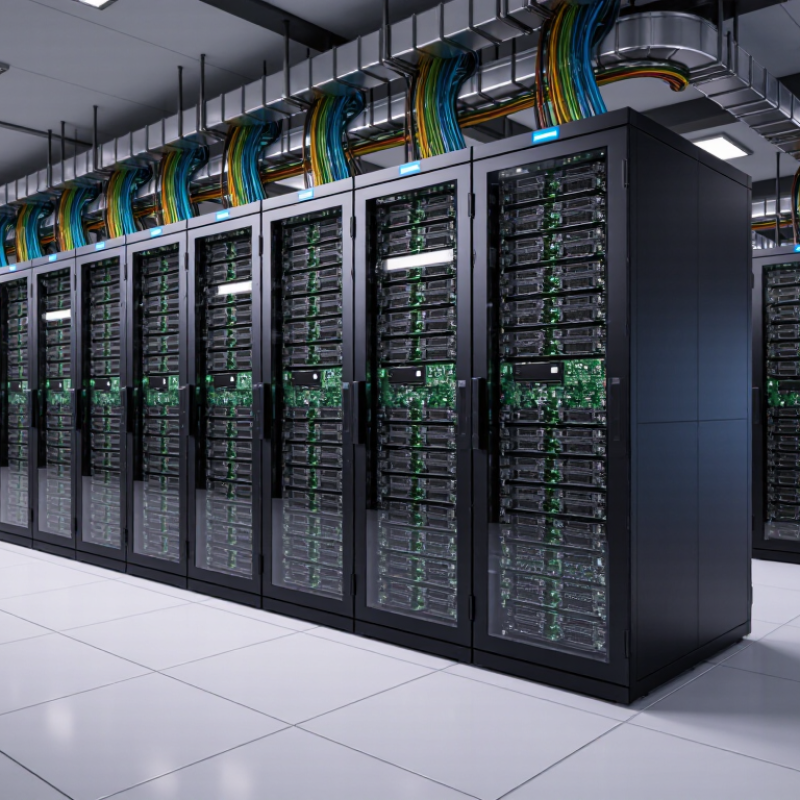
A machine learning server manufacturer does more than assemble a chassis. It converts AI workloads into validated systems, matching accelerators, processors, memory, networking, storage, and power supplies. Engineers test how these parts behave together under sustained training loads. Fit matters.
The role extends across the AI supply chain. Manufacturers coordinate component availability, firmware compatibility, rack layouts, and service requirements with suppliers and data-center operators. Gartner forecast worldwide AI spending would reach $1.5 trillion in 2025, reflecting rapid investment in AI infrastructure and services (Gartner, 2024). Yet demand does not guarantee dependable machines. A server may meet benchmark targets in a lab and still struggle with heat or power limits in a crowded rack. The boundary between manufacturer and systems integrator can be messy.
Energy constraints make design choices more consequential. The International Energy Agency’s Energy and AI report estimates data centers used about 415 terawatt-hours of electricity in 2024, potentially reaching 945 terawatt-hours by 2030. Manufacturers therefore assess power draw, cooling needs, and performance per watt—not just peak compute speed. They also document configurations and support replacement parts, helping operators plan deployments and maintenance. Those details are easy to understate, and real-world operating conditions can expose gaps that initial testing missed.
A machine learning server manufacturer should treat GPU memory as a design requirement, not a headline number. Some data-center accelerators provide up to 80 GB of HBM3 memory. That capacity can hold larger model weights, longer input sequences, or more examples in each training batch. It may also reduce transfers between GPU memory and system memory, which can slow workloads. Check the actual workload before choosing a configuration.
More memory helps, but it does not guarantee faster training. Model activations, optimizer states, and temporary buffers all consume space. For inference, long conversations can increase the memory needed for cached attention data.
Ask the manufacturer to test your model and typical batch size, then report memory use under load. Request details on cooling, power delivery, and supported GPU configurations, too. The number on a product sheet is only part of the picture.
A server that fits the budget but throttles during sustained work is a frustrating compromise. I would also leave some headroom; real workloads rarely behave as neatly as a benchmark.
A machine learning server manufacturer must design more than compute capacity; it must keep data moving between accelerators, memory, storage, and network cards. PCI-SIG’s PCI Express 5.0 specification sets signaling at 32 GT/s per lane. With 128b/130b encoding, that works out to roughly 3.94 GB/s per lane in each direction, before protocol overhead. A x16 link can approach 63 GB/s each way. Impressive, but not guaranteed application throughput.
PCI-SIG’s PCIe 4.0 and 5.0 specifications show the signaling rate doubling from 16 to 32 GT/s. In a server, engineers must also check slot wiring, switch topology, and the number of devices sharing an upstream link. A fast accelerator can still wait when storage or data preprocessing cannot keep pace. Small details matter: a shared x16 connection may become a bottleneck under simultaneous transfers. The specification gives a ceiling, not a complete performance forecast. That distinction is easy to overlook. In practice, measured workloads should guide final configuration choices.
What Is a Machine Learning Server Manufacturer?
Validate Training Performance with MLCommons MLPerf Benchmarks
A machine learning server manufacturer should demonstrate more than impressive hardware specifications. Buyers need evidence that a complete system can train models reliably, within a defined time and quality target. MLCommons’ MLPerf Training v4.0 results, published in June 2024, included a 70-billion-parameter language-model task. The benchmark measures time to reach a specified quality level, making results more useful than peak processing claims alone. Compare systems using the same benchmark version and workload.
The need for credible testing is growing. Stanford HAI’s AI Index Report 2024 estimates that training compute for notable AI models has doubled about every five months. That trend makes efficiency and repeatable performance important purchasing factors. Still, a benchmark run cannot represent every production data pipeline. No score is perfect. Ask whether the published result reflects the system configuration you can actually deploy, including accelerator count, memory, networking, software, and power requirements. Small configuration changes can affect results.
Tips: Request the full MLPerf submission details, not just a headline score. Check the quality target, system configuration, and run-to-run variation. Then test your own workload; real data can behave differently.
Use MLPerf benchmark results to compare machine-learning server configurations under defined workloads and rules. The metrics below describe what to verify; they are not vendor-specific performance results.
| Benchmark area | What is measured | Reported metric | What to validate in a server |
|---|---|---|---|
| MLPerf Training | Time required to train a specified model to its benchmark-defined quality target. | Time to target quality, generally reported in seconds. | Confirm the exact benchmark version, model, dataset, quality target, accelerator count, and complete system configuration. |
| MLPerf Inference — SingleStream | Inference requests processed one at a time, emphasizing response time. | Latency, typically reported in milliseconds. | Check end-to-end latency, including data movement and software overhead, under the benchmark’s rules. |
| MLPerf Inference — Server | Inference requests served in a server-like setting with a prescribed latency constraint. | Throughput, such as queries per second, subject to the required latency rules. | Verify the latency constraint, achieved throughput, request handling, and configuration used for the result. |
| MLPerf Inference — Offline | Inference over a supplied dataset without an interactive request-arrival pattern. | Throughput, commonly expressed as samples per second. | Check sustained processing rate, accelerator utilization, and whether the reported workload and accuracy requirements match. |
| MLPerf Inference — MultiStream | Multiple inference streams processed concurrently under scenario-specific timing requirements. | Latency and stream performance, according to the applicable benchmark rules. | Review concurrent workload behavior, per-stream requirements, and the tested number of streams. |
| System configuration | The hardware and software environment used to produce a benchmark result. | Configuration details; not a performance metric. | Compare accelerator and CPU counts, memory, interconnects, cooling, firmware, drivers, libraries, and software versions. |
| Result verification | Whether a result follows the applicable MLPerf rules and is documented for the relevant benchmark round. | Submission status and published result details. | Check the MLCommons result page, benchmark version, scenario, system description, and any required notes before comparing results. |
Comparisons are meaningful only when benchmark versions, workloads, scenarios, quality targets, and system configurations are aligned. Consult the corresponding MLCommons publication for official results and rules.
What Is a Machine Learning Server Manufacturer?
Plan Cooling Around ASHRAE’s 18–27°C Recommended Inlet Range
A machine learning server manufacturer designs or assembles systems for demanding computing workloads. Dense accelerators can produce substantial heat in a small rack footprint. Cooling plans should therefore start at the server inlet, not with the room thermostat alone. ASHRAE’s 18–27°C recommended inlet range is a useful planning reference, but it is not a substitute for each system’s operating specifications. Small shifts matter.
Measure air at the front of the servers, where equipment draws it in. Aisle temperature can hide a warm pocket near the top of a rack, while a sensor on a wall may miss both. Keep supply air paths clear, manage cable openings, and check return air for signs of recirculation. These details are easy to overlook. They are also where a tidy diagram can meet a less tidy room.
Monitor inlet readings under realistic workloads, including periods when accelerators run near capacity. If temperatures drift toward the upper end of the range, adjust airflow or cooling before relying on higher fan speeds alone. Measure, then adjust. No single temperature setting fits every facility, and readings deserve regular review as server configurations change.
Use the recommended server inlet temperature range as a practical target when designing and monitoring cooling for machine learning hardware.
ASHRAE’s recommended inlet range shown here is 18–27°C. Measure air at the equipment air intake, rather than relying only on room temperature, and use intake readings to guide airflow and cooling adjustments.
It combines accelerators, processors, memory, networking, storage, and power supplies into tested systems. Fit matters.
Components can behave differently under sustained training loads. Testing helps reveal heat, power, and compatibility problems before deployment.
They work with suppliers and data-center operators on component availability, firmware, rack layouts, and service needs. Small details matter.
Estimates suggest global data-center electricity use could reach 945 terawatt-hours by 2030. That is a large planning challenge.
It signals at 32 GT/s per lane. A x16 link can approach 63 GB/s in each direction, before overhead.
No. Actual throughput depends on protocol overhead, slot wiring, switches, and shared links. Not always.
Several devices may compete for one upstream link. A shared x16 connection can become a bottleneck during simultaneous transfers.
Storage or data preprocessing may not keep pace with accelerators. Specifications show ceilings, not guaranteed results. Real racks can surprise engineers.
A machine learning server manufacturer designs and integrates the hardware that supports AI workloads, connecting processors, accelerators, memory, storage, and networking into systems suited to model training and inference. Its role extends beyond assembling components: it must balance performance, reliability, power use, and upgradeability while ensuring the system can move large datasets efficiently. For demanding workloads, accelerator memory is a key consideration; configurations with up to 80 GB of high-bandwidth memory can help accommodate larger models and data batches.
High-speed I/O also matters. PCIe 5.0 provides 32 GT/s per lane, helping reduce bottlenecks between accelerators and other components. Manufacturers can validate training performance with standardized machine-learning benchmarks and compare results across relevant workloads. Finally, cooling should be planned around the system’s heat output and operating conditions, with inlet air generally maintained within a recommended range of 18–27°C. Together, careful component selection, performance testing, and thermal design help produce dependable servers for AI development and deployment.