Veltrixa
China’s AI infrastructure market includes manufacturers building systems for model serving, data-center deployment, and enterprise workloads. This guide introduces ten companies associated with AI inference servers and explains the factors buyers can compare. An ai inference server manufacturer may offer different processor options, accelerator configurations, memory capacities, and cooling designs. Those details shape how well a server fits a particular workload.
Performance is only part of the decision. Buyers should also examine power use, network capacity, software compatibility, service coverage, and upgrade options. Small details matter. A clear specification sheet is useful, but it cannot replace testing with representative models and realistic traffic. Published figures may rely on different hardware, software, or measurement methods, so comparisons need care. That deserves scrutiny.
The companies in this overview should be assessed against practical deployment needs, not treated as interchangeable suppliers. A compact system for edge applications has different requirements from a rack-scale platform serving large models. Readers can use the list as a starting point, then verify current product specifications, support terms, and deployment references directly with each vendor. Ask for evidence. Manufacturer capabilities and product lines change over time, and public information may not answer every question. This overview is therefore a guide, not a final purchasing verdict. The best choice depends on workload, budget, infrastructure, and the support a team can actually obtain.
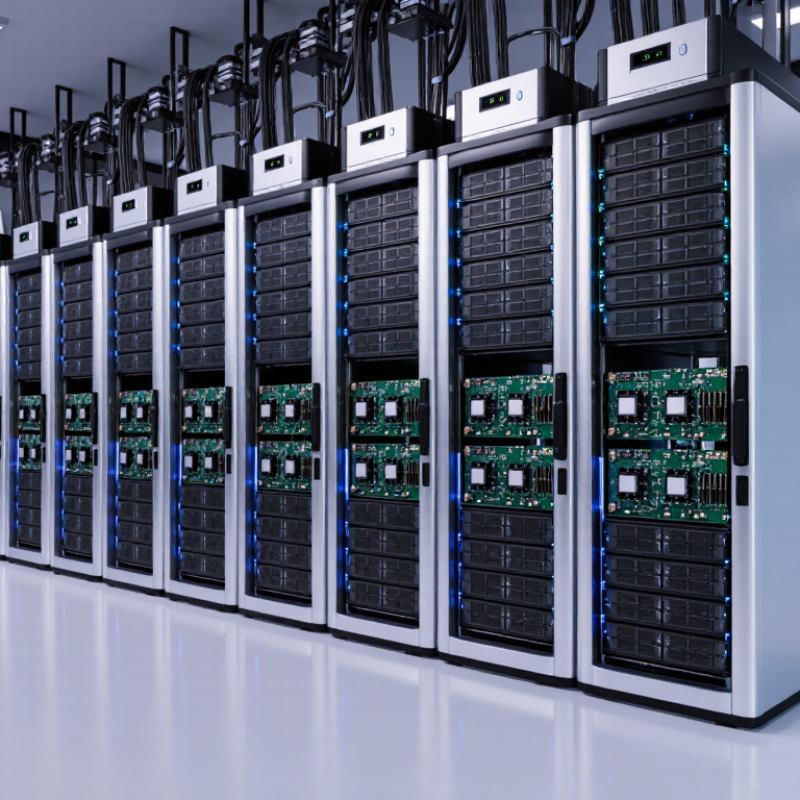
An AI inference server runs a trained model to respond to live requests. Unlike a training system, it applies learned parameters to new inputs. A user submits text, an image, or another supported signal. The server prepares the input, places data in memory, and sends calculations to CPUs, GPUs, or specialized accelerators. The model returns a prediction or generated response. This is where AI meets everyday use.
For a language model, the server converts text into tokens and processes them through layers of numerical operations. It generates output one token at a time, though batching can help hardware handle several requests together. Batching may improve throughput. It can also increase waiting time. Queues, memory capacity, network speed, and model size all affect response quality and speed. Small details matter.
Operators track latency, tokens per second, hardware utilization, and errors. They may adjust batch limits, caching, or model placement as demand changes. There is no universal configuration: a setup suited to short prompts may struggle with long context or sudden traffic. Real deployments are messier than diagrams suggest. Tests can mislead when their inputs do not resemble real workloads. Careful measurement is essential, and tuning often means balancing speed, cost, and consistency.
China’s AI inference server market is organized as a connected supply chain, not a single product category. Accelerator and memory suppliers shape available configurations; server makers assemble systems; integrators adapt them for data centers and enterprise sites. IDC estimated China’s AI server market at US$7.1 billion in 2022, up 25.9% year on year, in its China AI infrastructure market research. The China Academy of Information and Communications Technology reported roughly 230 EFLOPS of national computing capacity in 2023, including about 70 EFLOPS of intelligent computing. These figures show why the market spans both hardware production and capacity planning.
The final system is often tuned to a specific workload. A cloud operator may prioritize rack density and utilization, while a factory may need predictable latency beside existing control systems. Integrators therefore test accelerator compatibility, cooling, networking, and management software before deployment. The boundary is messy. Some suppliers cover several layers, and procurement can involve both direct sales and project-based integration. This map is useful, but imperfect: public market figures do not cleanly separate inference servers from systems also used for training. Buyers should compare measured throughput, power draw, and service coverage under their own workloads, rather than rely on peak specifications alone.
China Top 10 AI Inference Server Manufacturers
Key Technologies That Shape Inference Server Performance
Inference performance depends on more than accelerator speed. Memory bandwidth affects how quickly model weights and cached tokens reach processors. Large language models also rely on key-value caches to reduce repeated computation. If memory is tight, servers may process fewer simultaneous requests or experience longer response times. The MLPerf Inference v4.1 benchmark evaluates workloads across different scenarios, including server and offline tests. Its results are useful, but real-world performance also depends on model size, request patterns, and software configuration.
Power and cooling matter, too. The International Energy Agency’s Electricity 2024 report estimated data centers used about 460 TWh of electricity in 2022, with demand potentially exceeding 1,000 TWh by 2026. Efficient power delivery and thermal design can help maintain stable performance during sustained workloads. Network bandwidth and low-latency connections are also important when multiple servers share model data. A fast chip can still wait on data. That part is easy to overlook.
Tips: Compare throughput and latency using your own model and typical request lengths. Check memory capacity, power draw, and cooling under sustained load—not just short benchmark runs. A published score is a starting point, not a guarantee.
A practical profile of China’s ten AI inference server manufacturers should compare engineering choices, not just peak performance. The market includes large system integrators, network-equipment groups, and specialist compute builders. Their product sheets may look similar; rack-level behavior often does not. Check sustained throughput, memory bandwidth, accelerator compatibility, and service access. Cooling matters. So do power draw and maintenance clearance.
TrendForce forecast global AI server shipments at 1.67 million units in 2024, up 41.5% year on year (TrendForce, 2024). IDC’s Worldwide AI and Generative AI Spending Guide projected global AI spending of US$632 billion by 2028, with a 29% compound annual growth rate from 2024 to 2028. These figures indicate demand, not guaranteed sales for any supplier. That distinction is easy to miss.
Each profile should document target workloads, memory configuration, networking, and thermal design. Compare deployment evidence, including inference latency under load, tokens per watt, and time needed to replace fans or power modules. Ask whether tests were independently witnessed. Often, they were not. Public specifications can hide firmware limits, while customer references may omit workload details. A fair top-ten comparison should explain its scoring method and separate verified results from supplier claims. It will still be incomplete; availability and support quality change quickly.
Lower-bit formats can reduce the storage required for model values, though actual memory use and inference performance depend on the model, hardware, and implementation. These are format specifications, not manufacturer benchmarks.
Choosing an AI inference server manufacturer in China starts with your workload, not a product label. Estimate model size, concurrent requests, and acceptable response time. Then compare accelerator memory, network bandwidth, storage, and cooling design. A server that handles a large model may still struggle when many users send requests at once. Ask for test results using your model and realistic traffic, not only peak performance figures.
Check how each manufacturer documents compatibility with your inference framework, drivers, and monitoring tools. Request power draw and heat output under sustained use; these affect rack planning and operating costs. Review warranty terms, spare-part availability, and support response procedures. A polished benchmark sheet can mislead if test conditions are unclear. I would also ask for a small pilot, because deployment details sometimes expose gaps that specifications hide.
Tips: Compare identical workloads and settings. Confirm who handles updates and troubleshooting. Keep some capacity for growth, but avoid buying far beyond current needs. One detail is easy to miss: performance may vary with prompt length and batching. Record those assumptions before comparing quotes.
It connects accelerator and memory suppliers, server makers, and data-center integrators. Some suppliers cover several layers, so the boundaries can be blurry.
It was estimated at US$7.1 billion, up 25.9% from the previous year. The figure includes systems that may support both inference and training.
Compare sustained throughput, memory bandwidth, accelerator compatibility, and network capacity. Peak specifications alone can hide real workload limits.
Use the intended model and realistic request volumes. Record latency, power draw, and performance when several users send requests at once.
They affect rack planning, operating costs, and maintenance access. Check heat output during sustained use, not just brief tests. Cooling matters.
Review warranty terms, spare-part availability, and response procedures. Ask who handles updates and troubleshooting; that responsibility can be easy to overlook.
Results depend on test conditions, prompt length, and batching. Ask whether tests were independently witnessed. Often, that detail is missing.
Yes. A pilot can reveal compatibility or service gaps that product sheets miss. Still, one test may not reflect every deployment condition.
This article explains what AI inference servers are and how they process trained models to deliver results for applications in real time. It outlines how China’s AI inference server market is organized, from manufacturers and system integrators to the organizations that deploy and support server solutions. It also introduces the technologies that influence inference performance, including processor and accelerator options, memory capacity, networking, cooling, and software compatibility.
The article profiles ten types of leading manufacturers in China without focusing on brand names, highlighting the range of capabilities and solutions available. It then offers practical criteria for comparing each ai inference server manufacturer, such as workload requirements, performance, scalability, energy efficiency, reliability, support, and total cost of ownership. Together, these sections help readers understand the market and make a more informed choice when selecting an inference server solution.